

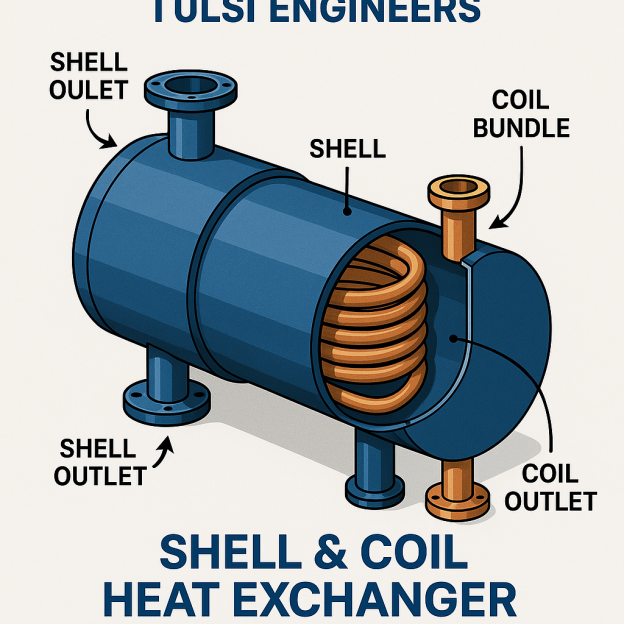
A Shell & Coil Type Heat Exchanger is a compact, high-efficiency heat transfer device designed for heating or cooling applications where space saving, reliability, and ease of maintenance are essential. Unlike conventional shell & tube designs, the coil type exchanger utilizes a helical or spiral wound coil placed inside a cylindrical shell. The coil bundle provides a large heat transfer surface area in a relatively small volume, ensuring superior thermal efficiency and uniform heat distribution.
The working principle involves one fluid circulating inside the helical coil while the other fluid flows around the coil within the shell. The helical configuration induces turbulence, improves heat transfer rates, and minimizes fouling tendencies. Its unique geometry offers self-cleaning characteristics, reduces pressure drop, and maintains high performance even under demanding operating conditions.
Shell & coil exchangers are widely used for applications such as hot water generation, process fluid heating, cooling water systems, oil cooling, steam-to-water heat transfer, and HVAC systems. Their rugged construction, thermal efficiency, and ease of installation make them highly suitable for industrial, commercial, and institutional applications.
Technical Highlights
- Construction Type: Cylindrical shell with helically wound coil bundle inside.
-
Material of Construction (MOC):
- Carbon Steel, Stainless Steel (SS304 / SS316), Copper, or Duplex Steel depending on process requirement.
- Operating Pressure: Typically up to 16–25 bar (higher ratings available on request).
- Operating Temperature: Suitable for temperatures up to 300°C, depending on coil and shell material.
-
Heat Transfer Efficiency:
- High turbulence due to helical flow ensures excellent heat transfer coefficients.
- Compact size provides large surface area per unit volume.
- Flow Arrangement: Counter-current or parallel flow, based on duty requirement.
-
Design Features:
- Self-cleaning effect of helical coils reduces scaling and fouling.
- Low pressure drop across both shell and coil sides.
- Easy to dismantle, clean, and maintain.
- Compact design with small footprint compared to conventional shell & tube exchangers.
-
Applications:
- Steam-to-water heating (hot water generation for process or utility).
- Oil cooling in hydraulic and lubrication systems.
- Chilled water applications in HVAC.
- Heat recovery in process industries.
- Food, pharmaceutical, and chemical industries where hygiene and corrosion resistance are critical.
✅ Summary:
The Shell & Coil Heat Exchanger offers a reliable and efficient solution for transferring heat between fluids in industrial and commercial systems. Its compact size, high thermal efficiency, low maintenance needs, and versatility make it a preferred choice over conventional exchangers for many process and utility applications.