

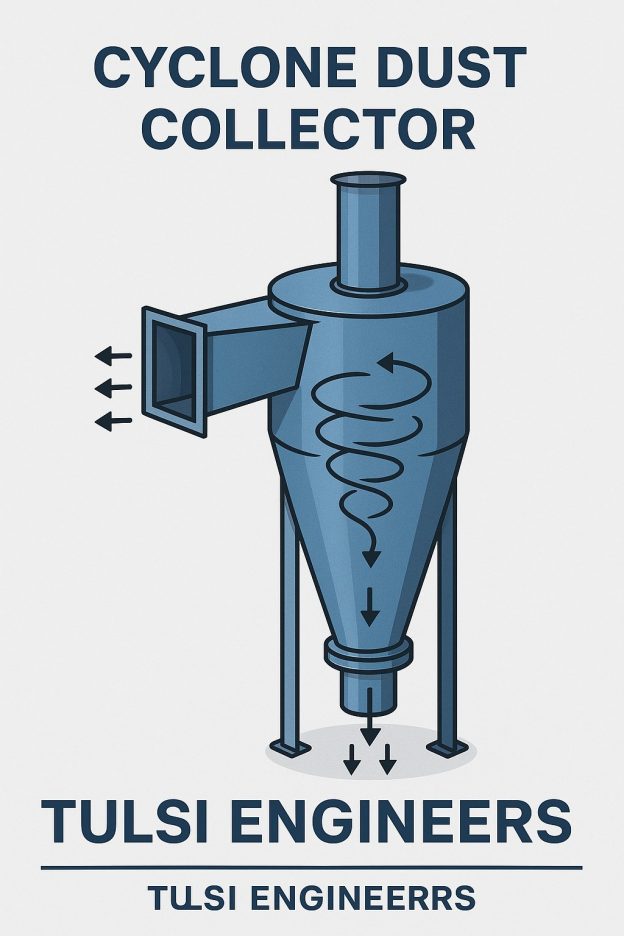
Cyclone Dust Collectors are mechanical air pollution control devices designed to separate dust, particulate matter, and other solid contaminants from process gases or air streams. They work on the principle of centrifugal force, using a high-speed rotating airflow to push heavier dust particles outward toward the cyclone wall while allowing cleaner air or gas to exit through the top. This simple yet effective method of separation makes cyclone dust collectors a reliable and low-maintenance solution for handling large volumes of dust-laden air.
These systems are widely used in industries such as cement, steel, foundries, food processing, chemical plants, power generation, woodworking, and material handling where the removal of coarse and medium-sized particles is critical for both environmental compliance and process efficiency. Unlike fabric filters or baghouses, cyclone dust collectors do not rely on filter media, making them particularly suitable for high-temperature, abrasive, or fibrous dust applications.
Cyclones can be used as primary dust collection units or as pre-cleaners before high-efficiency dust control systems like bag filters, scrubbers, or electrostatic precipitators. They are available in single-cyclone or multi-cyclone configurations, depending on process requirements and dust load. Their sturdy construction, low operating cost, and ability to handle a wide range of dust types make them one of the most versatile air pollution control devices in industrial environments.
Technical Highlights of Cyclone Dust Collectors
- Working Principle: Operates on centrifugal separation, where dust-laden air enters tangentially, creating a vortex. Heavy particles are thrown toward the walls and collected at the bottom, while clean air exits through the top.
- Efficiency Range: Typically achieves 70–95% collection efficiency for particles above 10 microns. Multi-cyclone systems can improve efficiency for smaller particles.
-
Design Variants:
- Single Cyclone Collectors – Suitable for medium to heavy dust loads.
- Multi-Cyclone Collectors – Multiple smaller cyclones arranged in parallel to increase efficiency for fine dust removal.
- Construction Materials: Available in carbon steel, stainless steel, abrasion-resistant steel, or lined with ceramic/FRP depending on the dust nature and operating temperature.
- Operating Capacity: Can handle large volumes of air/gas ranging from a few hundred m³/hr to over 1,00,000 m³/hr.
- Pressure Drop: Generally in the range of 50–200 mmWC, depending on design and application.
- Temperature Resistance: Can operate effectively at high temperatures up to 450°C (or more with special refractory/ceramic lining).
-
Applications:
- Pre-cleaner for boilers, furnaces, kilns, and dryers.
- Dust control in cement plants, steel plants, and power stations.
- Sawdust and wood-chip collection in woodworking industries.
- Grain, food, and pharmaceutical dust separation.
- Handling abrasive and fibrous dusts where filter clogging is an issue.
-
Advantages:
- Simple and rugged construction.
- Low capital and operating cost.
- No moving parts, hence minimal maintenance.
- Suitable for high-temperature and abrasive applications.
- Can be easily integrated with other pollution control devices.