

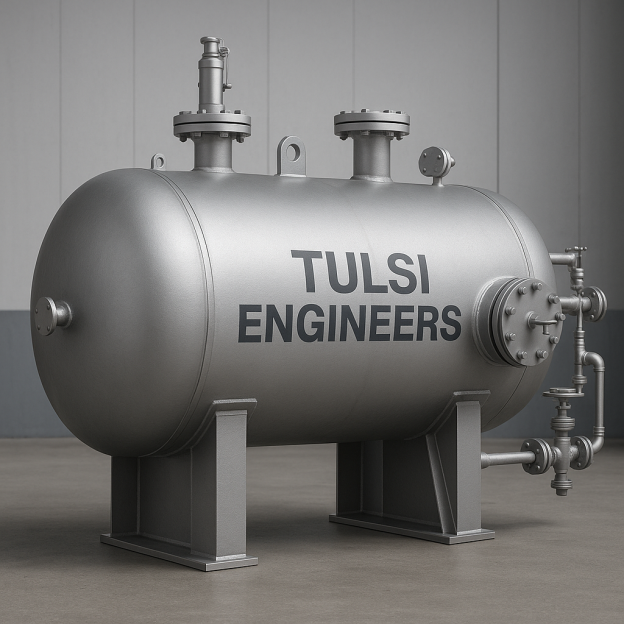
Industrial pressure vessels are specially engineered containers designed to hold gases or liquids at pressures significantly different from the ambient environment. These vessels play a crucial role in various industries, including oil & gas, petrochemicals, chemical processing, power generation, pharmaceuticals, and food processing.
Fabricated in compliance with stringent international codes such as ASME Section VIII, IBR, and PED, pressure vessels are manufactured using high-grade materials like carbon steel, stainless steel, alloy steel, or special composite materials, depending on the application.
The design of these vessels takes into account operating pressure, temperature, corrosion allowance, safety factors, and stress analysis to ensure long-term reliability, efficiency, and operator safety. They are widely used for processes such as storage, separation, reaction, and heat transfer under controlled conditions.
Advanced manufacturing techniques such as welding, stress relieving, hydro testing, and non-destructive testing (NDT) ensure structural integrity and compliance with international quality standards. Each pressure vessel is designed for durability, operational safety, and ease of maintenance, making them an indispensable asset in industrial operations.
Technical Highlights of Industrial Pressure Vessels
-
Design Standards & Codes:
- Manufactured as per ASME Section VIII, Div. 1 & 2, IS standards, IBR (Indian Boiler Regulation), and international norms.
- FEA (Finite Element Analysis) and stress design validation for high reliability.
-
Construction Materials:
- Carbon Steel, Stainless Steel (SS 304, SS 316), Duplex Steel, Alloy Steel, and Cladded materials.
- Corrosion-resistant lining and coatings available for aggressive chemical environments.
-
Operating Range:
- Pressure: Atmospheric to 300 bar (customized higher ratings available).
- Temperature: –50°C to +600°C depending on material selection.
-
Types of Pressure Vessels:
- Storage Vessels (for gases & liquids)
- Heat Exchanger Vessels
- Separator Vessels (two-phase & three-phase)
- Reactor Vessels
- Air Receivers & Surge Vessels
-
Testing & Inspection:
- 100% Radiography & Ultrasonic Testing (UT) for weld joints.
- Hydrostatic & Pneumatic Pressure Testing.
- Non-Destructive Testing (NDT): Dye Penetrant, Magnetic Particle, and Impact Tests.
-
Fabrication Features:
- Heavy-duty dished ends (Ellipsoidal, Torispherical, or Hemispherical).
- Skirt or saddle-mounted supports as per requirement.
- Internal trays, baffles, and coils for specific process needs.
- Heat insulation & refractory lining for high-temperature applications.
-
Safety & Reliability:
- Equipped with Pressure Relief Valves, Rupture Discs, and Safety Accessories.
- Designed with adequate corrosion allowance and fatigue resistance.
- Long service life with minimal maintenance.
-
Applications:
- Oil & Gas Refineries
- Petrochemicals & Chemical Plants
- Food & Beverage Industry
- Pharmaceutical Industry
- Power Plants & Steel Industry