

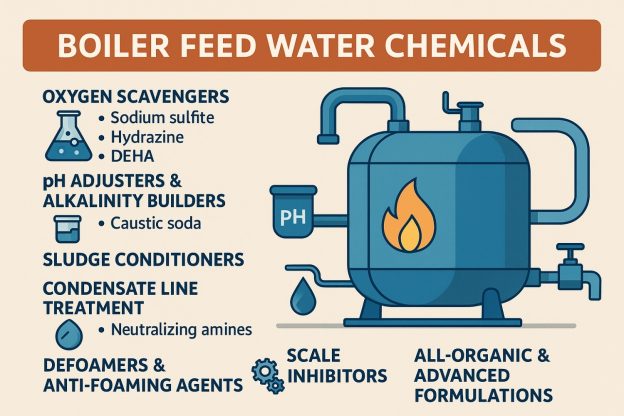
Boiler feed water chemicals are specialized formulations used in industrial boilers, power plants, and process heating systems to ensure reliable boiler operation, minimize downtime, and extend the equipment’s service life. Since boiler feed water is often sourced from natural supplies, it typically contains dissolved solids, oxygen, carbon dioxide, hardness salts, and other impurities that can cause corrosion, scaling, and fouling inside the boiler system. Boiler feed water chemicals are designed to treat these impurities, providing effective protection against both high-pressure and low-pressure boiler challenges.
The use of these chemicals is critical because even small amounts of dissolved salts and oxygen can lead to tube failure, overheating, or costly repairs. By conditioning the feed water with appropriate treatment chemicals, operators maintain heat transfer efficiency, reduce maintenance costs, and improve overall steam quality.
These chemicals work through a combination of oxygen scavenging, pH control, scale inhibition, sludge conditioning, and corrosion prevention. Selection of the right blend depends on boiler pressure, feed water quality, and operating conditions.
Technical Highlights of Boiler Feed Water Chemicals
-
Oxygen Scavengers
- Eliminate dissolved oxygen, which is the primary cause of corrosion.
- Common scavengers include sodium sulfite, hydrazine (or safer substitutes like carbohydrazide and DEHA).
- Prevents pitting corrosion on boiler tubes and feed lines.
-
pH Adjusters & Alkalinity Builders
- Maintain feed water pH in the safe operating range (usually 8.5–9.5).
- Chemicals like caustic soda (NaOH) or blended alkalinity builders control acidity.
- Ensures protection of boiler internals against acidic corrosion.
-
Scale Inhibitors
- Prevent deposition of calcium, magnesium, silica, and other hardness salts.
- Utilize phosphates, chelating agents, or polymeric dispersants.
- Improve heat transfer efficiency and reduce fuel consumption.
-
Sludge Conditioners
- Convert scale-forming salts into a soft, non-adherent sludge.
- Keeps impurities in suspension until they are removed via blowdown.
- Enhances boiler cleanliness and prevents hot spots.
-
Condensate Line Treatment
- Neutralizing amines (e.g., morpholine, cyclohexylamine) or film-forming amines protect condensate lines from carbonic acid attack.
- Extends the lifespan of steam distribution and condensate return systems.
-
Defoamers & Anti-Foaming Agents
- Prevent boiler water foaming and carryover of dissolved solids into the steam.
- Ensures high-quality, dry steam and protects downstream equipment like turbines.
-
All-Organic & Advanced Formulations
- Modern boiler feed water chemicals use eco-friendly, all-organic dispersants, and oxygen scavengers.
- Provide reliable performance in high-pressure boiler applications.
Key Benefits
- Prevents scaling, corrosion, and fouling inside the boiler.
- Ensures high heat transfer efficiency and reduces energy loss.
- Extends boiler life and reduces unplanned shutdowns.
- Improves steam quality for critical industrial applications.
- Reduces overall water and chemical consumption through optimized treatment.
✅ In short, boiler feed water chemicals are a comprehensive water treatment solution ensuring efficiency, reliability, and safety of industrial steam generation systems.